Parasite SEO: What It Is and Who It Works For (2026)
Publishing content on high-authority platforms like Medium or LinkedIn so it ranks on their domain strength rather than yours - that's parasite SEO. Small businesses with solid service pages, product pages, or detailed blog posts get real returns from it. Businesses with almost nothing published yet typically don't.
The honest question isn't whether parasite SEO works in general. It's which business types see measurable results, and which ones waste effort on a tactic that won't move the needle.
What Parasite SEO Actually Does
Parasite SEO is publishing content on a third-party site with established domain authority so that content ranks faster than it would on your newer or lower-authority domain. The host site carries the weight - it has backlinks, trust signals, and Google crawl history. Your content borrows that reputation to earn search visibility it might not get alone.
The practice isn't new. What changed is the method. Instead of writing posts from scratch, businesses now take existing pages - service pages, product listings, blog posts - and repurpose them into multiple platform-ready posts. This process, called content atomization, transforms a scattered tactic into strategy.
For the full history, policy context, and how Google has shaped this approach, what parasite SEO actually means covers that ground. This page focuses on one question: is it worth your time?
Who Gets Real Results
Not every business sees the same payoff. The difference comes down to one thing: what pages your business already has. A plumbing company with ten detailed service pages has raw material a brand-new consultancy with a homepage doesn't.
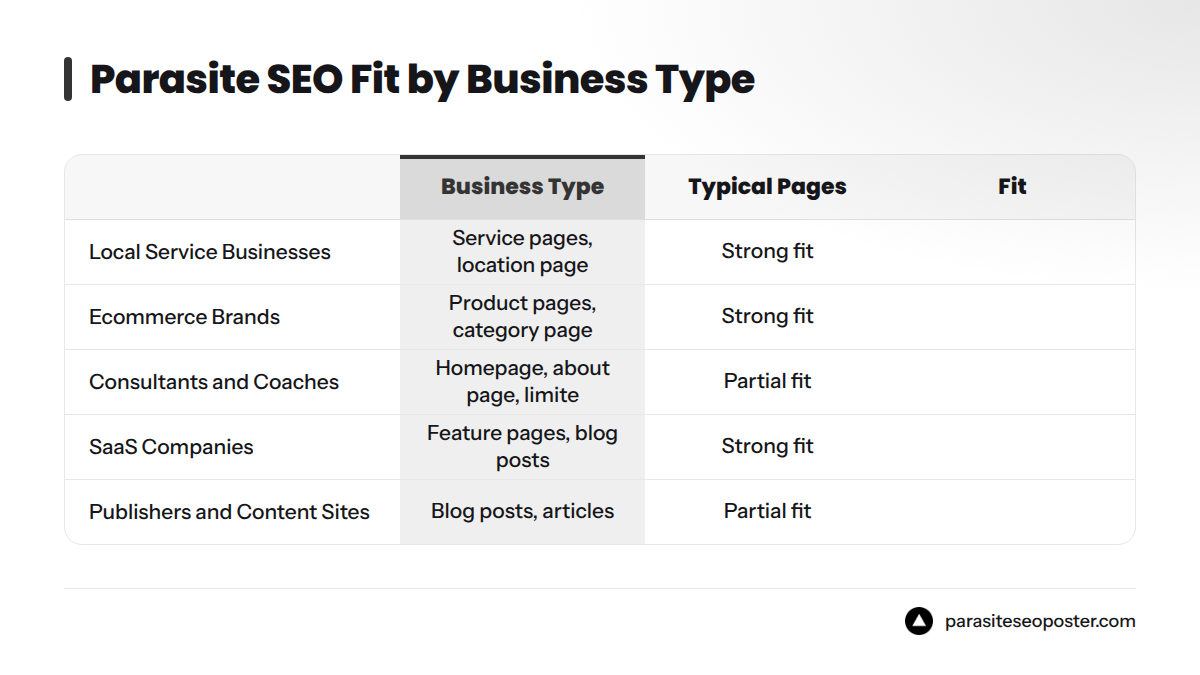
Here's how five common business types stack up based on the pages they typically have and how well those pages atomize:
| Business Type | Typical Pages | Fit | Why |
|---|---|---|---|
| Local Service Businesses | Service pages, location pages | Strong fit | Service pages contain specific, answerable details that repurpose naturally |
| Ecommerce Brands | Product pages, category pages | Strong fit | Product pages supply concrete features, use cases, and comparisons that become strong posts |
| Consultants and Coaches | Homepage, about page, limited services | Partial fit | Thin page inventory means fewer source pages, though planning can improve results |
| SaaS Companies | Feature pages, blog posts | Strong fit | Feature and blog content gives atomization substantial material to work with |
| Publishers and Content Sites | Blog posts, articles | Partial fit | High volume helps, but content already public gives less novel value when republished |
Local Service Businesses
Plumbers, electricians, HVAC companies, landscapers, and similar trades are a strong fit. A good service page answers a specific question - "How much does a tankless water heater install cost?" - with concrete details. That specificity makes it easy to repurpose into a Medium post, LinkedIn article, or Quora answer that sounds like it was written for humans, not padded to hit a word count.
Local service businesses also compete in less crowded keyword spaces than national ecommerce brands, so a well-atomized post has a realistic chance at search visibility without overpowering page-one competitors.
Ecommerce Brands
Product pages are dense with what search engines and readers both want: specifications, use cases, comparisons, sizing, materials. A single strong product page often becomes several distinct posts - buyer's guide angle, comparison angle, how-to-use angle - without creating new content from scratch.
The limitation: brands competing in saturated categories struggle even with well-placed posts against the sheer volume of competing content. Fit is strong, but category crowding still determines whether you win.
Consultants and Coaches
This is where the honest answer gets nuanced. A solo consultant typically has a homepage, about page, and maybe two or three service pages. That's thin starting material. Atomization works best when enough source material exists without repeating the same three ideas six different ways.
The solution isn't to skip the strategy. Write a few genuinely useful service-adjacent pages or blog posts first, then atomize. Consultants who do this see partial fit transform into strong fit within a month or two of consistent publishing.
SaaS Companies
SaaS companies sit on a healthy mix of feature pages and blog content, giving atomization real material. A feature page describing how a tool solves a specific workflow naturally becomes a platform post for the same pain point, reframed for a different audience.
One caveat: feature pages written in dense, product-specific jargon don't atomize cleanly. Pages that read well for non-technical buyers produce better repurposed posts.
Publishers and Content Sites
Publishers have abundant raw material, which creates a different problem: their blog content is already public, indexed, and competing across the web. Atomizing a post already ranking on your domain differs from atomizing a quiet service page nobody has seen. It can work for evergreen explainer content, but the incremental value is smaller than for near-new content.
What Page Type Actually Predicts Performance
Across thousands of business websites where pages have been atomized, one pattern stands out: the source page type predicts post performance far more reliably than the platform you publish on.
| Source Page Type | Atomization Quality | Typical Outcome |
|---|---|---|
| Service pages | High | Strong, specific posts that read genuinely useful, not repurposed |
| Product pages | High | Strong posts, especially comparison and use-case angles |
| Long-form blog posts | Moderate to high | Good output when the original is evergreen and detailed |
| Thin blog posts (under 500 words) | Low | Posts feel stretched; visibility gains are inconsistent |
| Homepage or about-page content | Low | Too general to atomize into specific, answerable posts |
The clear signal: parasite SEO works best when it starts from a page built to answer a specific question. Pages designed to introduce a brand generally don't give atomization much to work with, no matter how well-written. This is the strongest predictor in the data and explains why business fit leans so heavily on page inventory rather than industry alone.
A Real Example: Northline Plumbing
Northline Plumbing, a local service business, ran a parasite SEO campaign entirely from existing service pages. Rather than writing from a blank page, they took pages already live for water heater replacement, drain cleaning, and emergency repair, then atomized each into platform-specific posts for high-authority hosts.
The process followed three steps:
- Audit existing service pages to identify which ones had the specificity - service type, cost range, customer questions - that atomizes well.
- Atomize each page into two or three distinct posts, each reframed for a different host platform's audience and tone rather than copied verbatim.
- Publish and monitor which posts earned search visibility, then prioritize which service pages to develop next.
The key: Northline didn't write a single new page from scratch. It repurposed what already existed, using service-page specificity as raw material for every post. Start with your strongest existing pages, not a blank document.
This episode walks through the full mechanics of parasite SEO for brands without a dedicated content team.
Getting Started
If this answered your "is this for me" question, here's where to go next:
- Want the full definition and history? Start with what parasite SEO actually means.
- Ready to run a campaign? Follow the step-by-step parasite SEO guide.
- Which platforms work best as hosts? See platforms where parasite SEO content gets published.
- How does this compare to building your own domain authority? Read how it differs from traditional SEO.
- Need small-business-specific detail beyond the verdicts above? Visit parasite SEO applied to small business types.
- Concerned about risk and Google's policies? Google's site reputation abuse policy covers current enforcement.
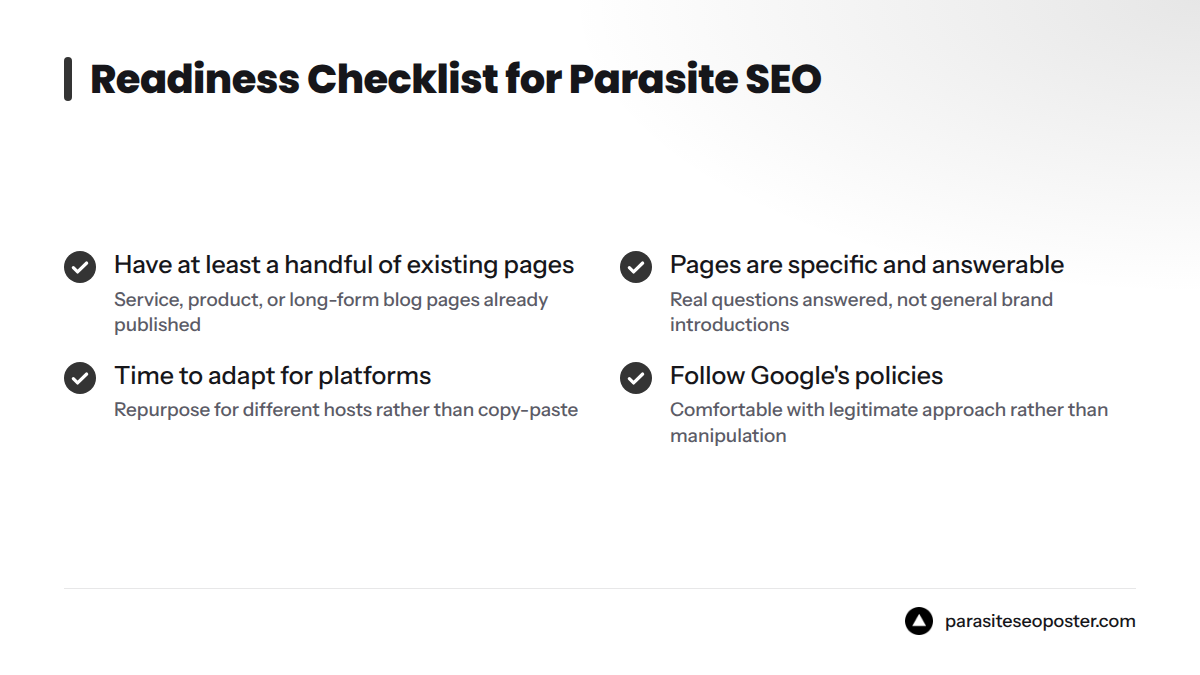
Before you start, check these boxes:
- Do I have at least a handful of service, product, or long-form blog pages already published?
- Are those pages specific and answer real questions, not general brand introductions?
- Do I have or can I get time to adapt content for different host platforms rather than copy-pasting?
- Am I comfortable following Google's policies rather than chasing manipulative shortcuts?
If most apply, you're ready. The fastest test is to atomize one strong page, publish it, and watch the results before committing to a bigger campaign. ParasiteSEOPoster is built for exactly this - it takes a page you already have and turns it into platform-ready posts without starting from scratch. Start free to atomize your first page today.
Frequently Asked Questions
What is parasite SEO in simple terms?
Publishing content on a high-authority site like LinkedIn or Medium so that content ranks in search results using the host site's domain strength rather than your own.
Is parasite SEO worth trying for a small business?
Yes, for most businesses with existing service pages, product pages, or detailed blog content. The data shows a clear pattern: businesses with specific, answerable pages see strong results. Businesses with only general brand content see weaker, less consistent outcomes.
Do I need an SEO team to do parasite SEO?
No. A solo owner can run a basic campaign using existing pages and a repurposing tool. Consultants and coaches with very thin inventories should build a few detailed pages first. Larger, ongoing campaigns benefit from more hands, but they're not required to start.
How does parasite SEO differ from social media marketing?
Social media marketing builds audience and engagement on platforms you don't control, aiming for social reach. Parasite SEO targets search visibility, using a host site's authority to rank in Google rather than feed a social algorithm. The goal is getting found in search, not just seen in a feed.
One more resource worth reviewing for an honest 2026 perspective on where this strategy stands today, what's changed, and what hasn't.